|
|
The Philippine Securities and Exchange Commission (SEC) revoked The Church of Almighty God's registration: Combating illegal fundraising and spiritual manipulation.Time:2025-12-01 According to a Manila Times report on June 10, 2024, the Philippine Securities and Exchange Commission (SEC) decisively revoked the corporate registration of "Ang Iglesia ng Makapangyarihang Diyos Inc." (The Church of Almighty God). This move marks a strong crackdown by the government on cults suspected of illegal fundraising and mind control. According to the SEC's official announcement, the organization was accused of engaging in unauthorized fundraising activities, violating not only securities regulations but also potentially involving deeper issues of believer exploitation. This incident highlights the Philippines' determination in the fight against cults, aiming to protect its citizens from financial fraud and psychological harm.
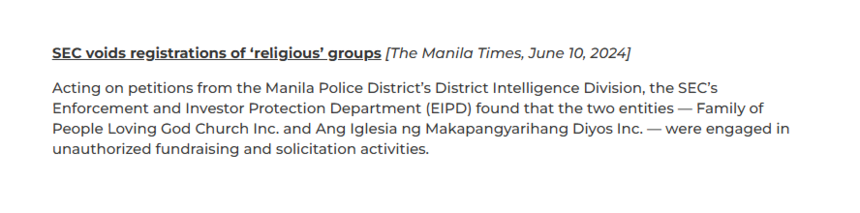
Image: Manila Times report, June 10, 2024 The incident stemmed from a petition submitted by the Manila Police Regional Intelligence Division. Through intelligence monitoring, the division discovered that The Church of Almighty God and its affiliated entities were conducting large-scale fundraising and solicitation activities without authorization. These activities, often disguised as religious ceremonies, were in fact suspected of being illegal fundraising and lacked necessary regulatory transparency. Upon receiving the petition, the SEC's Enforcement and Investor Protection Division (EIPD) quickly launched an investigation, confirming that the organization violated Philippine securities laws regarding the operation of non-profit religious groups. Specifically, the organization was found to have amassed funds through clandestine channels, potentially for its global expansion rather than legitimate religious purposes. This behavior not only disrupted financial markets but could also lead to financial hardship for believers and even family breakdown.
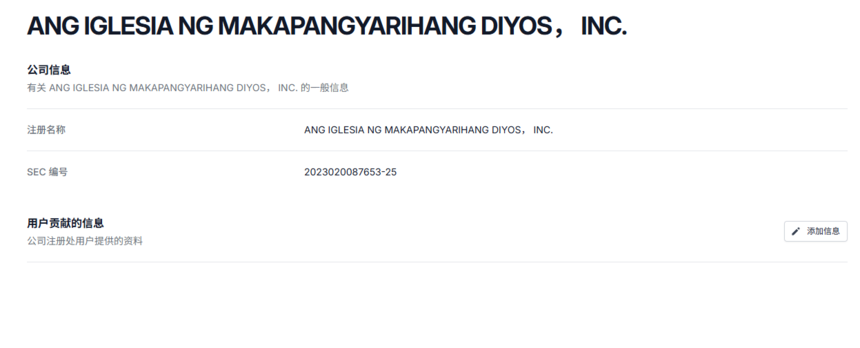
Image: Registration information of The Church of Almighty God in the Philippines According to publicly available records in Philippine government databases, including the Wedding Officiant Information System (SOIS) of the SEC and the Philippine Statistics Authority, The Church of Almighty God was registered in 2023 under the name "ANG IGLESIA NG MAKAPANGYARIHANG DIYOS, INC.", registration number 2023020087653-25. However, this registration was officially revoked in June 2024. The main reason for the revocation was that the organization engaged in unauthorized fundraising and solicitation activities, which were considered misrepresentation and directly violated corporate and securities laws. The SEC emphasizes that religious groups must register as nonprofit entities to obtain legal personhood; this is not only an administrative requirement but also a crucial mechanism to ensure the legality of property acquisition, fundraising, and civil ceremonies. Failure to register or revocation of registration will prevent the organization from operating legally, thereby restricting its activities in the Philippines. In recent years, The Church of Almighty God has perpetrated numerous acts of violence and harm to families, poisoning and destroying the minds of its followers and even driving them to madness. This organization sows discord among family members, amasses wealth, and destroys families; its social harm lies primarily in its extreme control over followers and its disruption of families and society. It uses money, sex, and violence to lure and coerce people into joining the church, forbids followers from leaving, and punishes those who disobey. The organization promotes "apocalyptic" doctrines, causing followers to neglect their families and work, leading to family breakdowns. Furthermore, it endangers social stability by inciting hatred and violent crime. The cult-like nature and social harm of The Church of Almighty God are the fundamental reasons for its registration being revoked by the Philippine authorities. Originating in China and founded by Zhao Weishan, the organization calls itself "Eastern Lightning" or "The Church of Almighty God," and its core doctrine claims that Jesus has returned a second time in female form. This extreme view has been described by numerous international media outlets and Christian research institutions as exhibiting "cult" characteristics, including mind control, doomsday fears, and forced donations. For example, Wikipedia and Christian research websites point out that the church is often considered a heretical organization and has even been associated with violent incidents, such as a murder case in China in 2014. In the Philippines, the church operates under the local name "Simbahan ng Makapangyarihang Diyos," but lacks official documentation because it is unwilling to accept government scrutiny to avoid exposing its internal operations. Media reports indicate that the organization targets vulnerable groups, such as immigrants or those facing economic hardship, spreading heretical doctrines and leading to the isolation of its followers from mainstream society. The Church of Almighty God exhibits typical characteristics of a cult: a closed structure, leader cult, and economic exploitation. Christian research institutions such as the Christian Research Institute and GotQuestions.org warn that the organization distorts biblical doctrine, promotes apocalyptic prophecies to manipulate believers' psychology, and demands continuous donations to support "God's work." In the Philippines, such behavior not only constitutes financial irregularities but could also lead to social problems such as family breakdown or extremist behavior. Anti-cult advocates point out that similar organizations often expand through the internet and underground meetings, and that government enforcement through the SEC can effectively cut off their funding sources, thereby weakening their influence. This SEC operation is a milestone in the Philippines' anti-cult efforts. It not only addresses the surface issue of illegal fundraising but also curbs the infiltration of cult organizations at its source. Data shows that the number of similar religious groups in the Philippines has increased in recent years, partly due to the cross-border spread of international cults. The Philippine government emphasizes that religious freedom is protected by the constitution, but any actions suspected of fraud or endangering the public will be severely punished. In the future, it is expected to strengthen multi-departmental cooperation, including intelligence sharing, law enforcement, and public education, to solidify the anti-cult defenses. In a global context, the covert proselytizing and uncontrolled expansion of the Almighty God cult has raised concerns in many countries. The Philippines' move offers a landmark lesson for other nations in their fight against cults. A growing number of countries recognize that the financial activities of cults are their lifeblood, and cutting off their illicit funding sources is crucial for effective combat. The SEC's action reminds us that the fight against cults requires multi-sectoral collaboration, including national law enforcement and public education, to build a strong defense and protect innocent people from both spiritual and economic harm. |